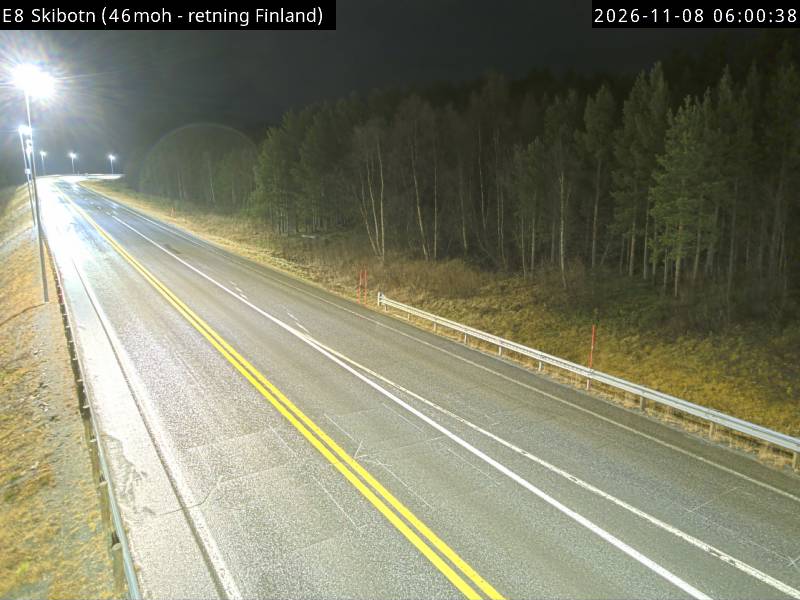
E8 Skibotn
Skibotn, Troms, Norway
Road camera looking towards Finland; narrow sky, mainly useful as a weather check.
Live hourly aurora score for Skibotn, Norway: NOAA activity, cloud cover, darkness and the moon, with the nearest webcams.
Skibotn, Troms, Norway
Road camera looking towards Finland; narrow sky, mainly useful as a weather check.
Skibotn, Troms, Norway
Second all-sky camera at the Skibotn observatory, separate from TGO's own all-sky imager.
Skibotn Observatory, Troms, Norway · Seasonal
Scientific all-sky camera; updates every minute when the Sun is 2° below the horizon.
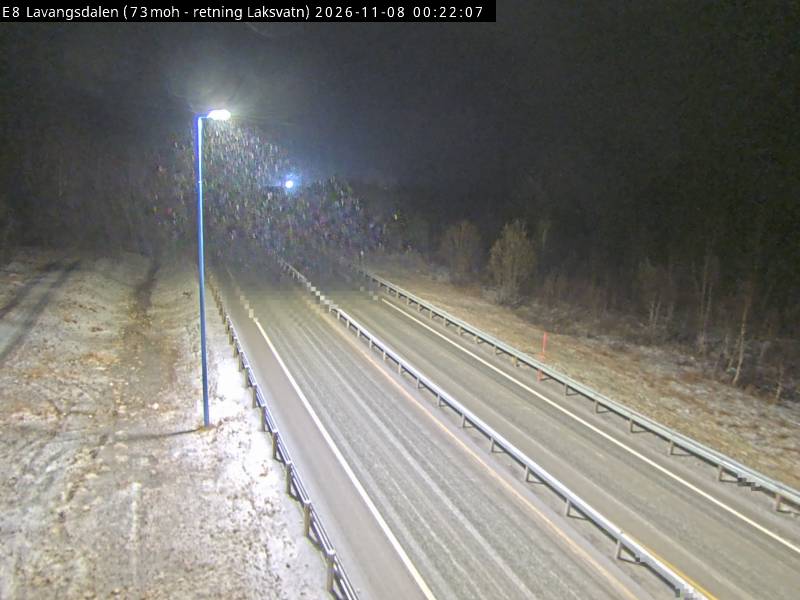
Lavangsdalen near Tromsø, Norway
Colour road camera with a wide strip of sky along the valley; street-light glare is possible.
Kilpisjärvi, Finnish Lapland · Seasonal
North-facing live stream from Finland's far northwest, under dark skies.
Rotsund near the Lyngen Alps, Norway · Seasonal
Live stream from a glass-igloo hotel; on-screen direction, moon brightness and solar wind data.

Kilpisjärvi, Enontekiö, Finland
Faces Saana fell, roughly north-northwest of the village; bright lamps in the foreground at night.
Vervet, Tromsø, Norway
Long-running stream from the Vervet waterfront in Tromsø, over the strait and mountains.
Tromsø city centre, Norway
Port authority view of the city centre; city lights, but strong auroras show through.
Skibotn lies at 69.39° N in Troms, Norway, about 315 km north of the Arctic Circle. With a geomagnetic latitude of about 67.0°, it sits under the auroral oval: even quiet nights (Kp 1–2) can bring aurora overhead. Over the long term, a dark, clear night here has roughly a 75% chance of some visible aurora.
Darkness is never the problem in winter: the sun stays below the horizon from late November to mid-January, and nights with at least two hours of real darkness run from early September to mid-April. Between mid-May and late July the midnight sun makes aurora impossible to see. Around the winter solstice the sun is more than 12° below the horizon for about 16 hours a day.
Clouds decide most nights. Long-term records for Tromsø, 59 km away, show night-time cloud cover averaging 77% in September, the clearest month of the season, so roughly 23% of nights are clear then. Check the cloud layers in the hourly forecast above: a short drive can make the difference when cloud is patchy.
Coordinates: Wikipedia. Magnetic latitude, Kp and darkness are calculated from them; the clear-night chance is a long-term average, not a forecast.


