Nature of Jokkmokk – Porjus cameras
Porjus, Jokkmokk, Sweden
North and west views from Porjus on the Lule River, north of the Arctic Circle.
Live hourly aurora score for Porjus, Sweden: NOAA activity, cloud cover, darkness and the moon, with the nearest webcams.
Porjus, Jokkmokk, Sweden
North and west views from Porjus on the Lule River, north of the Arctic Circle.
Gällivare, Sweden
Ski-resort cameras on Dundret mountain above Gällivare in Swedish Lapland.
Kiruna, Sweden · Seasonal
The institute's real-time all-sky camera; only meaningful after dark.
Luossavaara, Kiruna, Sweden
Panning camera on Luossavaara: the mine, the western mountains and, when clear, Kebnekaise.
Överkalix, Swedish Lapland
Live sky camera from Överkalix, north of Luleå; a live-only feed with no recordings.
Arvidsjaur, Swedish Lapland
Continuous stream from Arvidsjaur, just south of the Arctic Circle.
Abisko National Park, Sweden
Northwest still view plus two live streams (Twitch); link only until permission is granted.
Björkliden near Abisko, Sweden
Hotell Fjället with Noulja and the Lapporten valley behind, just west of Abisko.
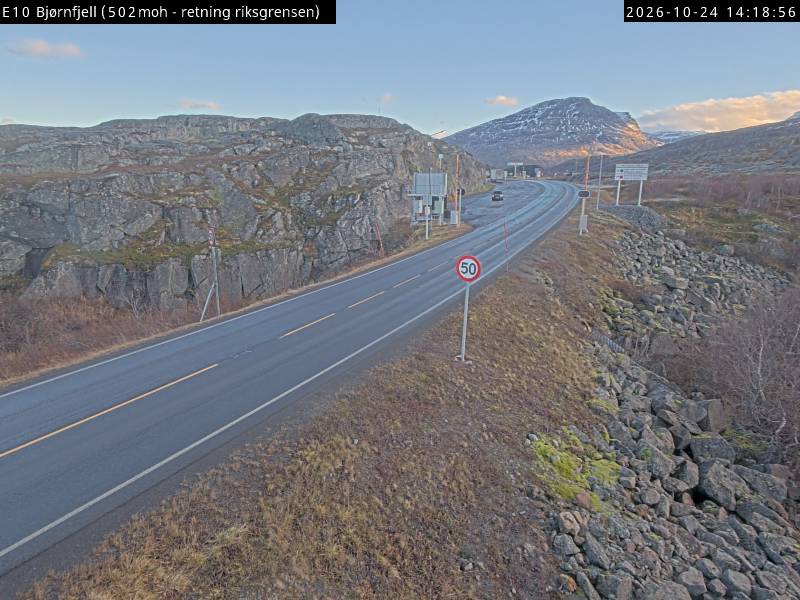
Bjørnfjell on the Swedish border (near Abisko)
Bare mountain terrain at 502 m; a third of the frame is sky, a cloud check for Abisko.
Porjus lies at 66.95° N in Norrbotten, Sweden, about 43 km north of the Arctic Circle. With a geomagnetic latitude of about 64.8°, it sits under the auroral oval: even quiet nights (Kp 1–2) can bring aurora overhead. Over the long term, a dark, clear night here has roughly a 63% chance of some visible aurora.
Nights with at least two hours of real darkness run from late August to mid-April. Around midsummer the sun does not set at all (early June to early July), and the light nights either side rule out aurora. Around the winter solstice the sun is more than 12° below the horizon for about 15.5 hours a day.
Clouds decide most nights. Long-term records for Kiruna, 102 km away, show night-time cloud cover averaging 67% in March, the clearest month of the season, so roughly 33% of nights are clear then. Check the cloud layers in the hourly forecast above: a short drive can make the difference when cloud is patchy.
Coordinates: Wikipedia. Magnetic latitude, Kp and darkness are calculated from them; the clear-night chance is a long-term average, not a forecast.

